
A practical guide to document retention periods in the UK — and when it’s safe to shred
When Is It Safe to Shred?
Most of us have a drawer, a filing cabinet or a cupboard full of old paperwork. Bank statements, tax returns, insurance letters, utility bills — they build up over the years and it is never quite clear when you can get rid of them. The result is that most people either keep everything forever or throw it all away at once, neither of which is ideal.
The good news is that there are clear guidelines on how long you need to hold on to most types of document. Once that period has passed, there is no reason to keep them — and every reason to shred them securely rather than put them in the bin, where they could be used for identity theft or fraud.
This guide covers the main types of household and business paperwork, how long you should keep each one, and what to do with them when the time comes.
Personal Documents
Bank Statements
If you are not self-employed, there is no legal requirement to keep bank statements for a set period. However, most financial advisers recommend holding on to them for at least two years. They can be useful as proof of payments, evidence in disputes, or supporting documents for mortgage and loan applications. After two years, they are generally safe to shred.
If you are self-employed or run a business, your bank statements form part of your tax records and should be kept for at least five to six years (see the tax records section below).
Utility Bills
Utility bills — gas, electricity, water, broadband — can usually be shredded after two years. The main reason to keep them is as proof of address, which is often required for identity verification, mortgage applications and account openings. Once you have more recent bills to serve that purpose, older ones can go.
Insurance Policies
Keep insurance documents for as long as the policy is active. Once a policy has expired and been replaced, there is usually no need to keep the old paperwork unless you are in the middle of a claim. For life insurance and critical illness cover, keep the documents for the full term of the policy.
Mortgage and Loan Documents
Keep mortgage statements, loan agreements and any related correspondence until the debt is fully repaid. After that, hold on to the final settlement letter and key documents for at least six years in case of any disputes. Once that period has passed, they can be shredded.
Credit Card Statements
Credit card statements follow the same general rule as bank statements — keep them for at least two years. If you use your credit card for business expenses, keep the statements for as long as you would keep your tax records.
Vehicle Documents
Keep your V5C logbook, MOT certificates and vehicle insurance documents for as long as you own the vehicle. When you sell or scrap the car, shred the old paperwork. The DVLA and your insurer hold their own records, so you do not need to keep yours beyond the point of ownership.
Medical Records
If you hold personal copies of medical letters, test results or prescriptions, it is sensible to keep these indefinitely. Your GP holds the official record, but having your own copies can be useful for reference, especially if you change surgery.
Receipts
Keep receipts for large purchases — appliances, electronics, furniture — for the duration of the warranty or guarantee period. For everyday purchases, receipts can be shredded once you are satisfied with the product. Business receipts should be kept in line with your tax records.
Business Documents
Self Assessment Tax Records
If you file a Self Assessment tax return, HMRC requires you to keep your records for at least five years after the 31 January deadline of the relevant tax year. For example, records relating to the 2024–25 tax year (deadline 31 January 2026) must be kept until at least 31 January 2031. This includes invoices, receipts, bank statements, mileage logs and any other documents that support your return.
Limited Company Accounting Records
Limited companies must keep their accounting records for at least six years from the end of the financial year they relate to. If the records cover a transaction that spans more than one accounting period, they should be kept for six years from the end of the later period. HMRC may require you to keep records for longer if you filed your company tax return late or if your return is under investigation.
VAT Records
If your business is VAT registered, you must keep VAT records for at least six years. For businesses involved in distance selling, the retention period is 10 years. VAT records include invoices, credit notes, import and export documents, and your VAT account.
Payroll and PAYE Records
By law, HMRC requires you to keep basic PAYE and payroll figures for the current tax year plus the previous three years. This includes pay rates, tax codes, and statutory deductions like sick or maternity pay. However, because payroll data is also needed to prove compliance with National Minimum Wage and holiday pay laws, it is highly recommended to hold on to these records for six years. Once that six-year mark passes, they should be securely shredded to protect your staff’s sensitive financial data.
Employee Records
Keep files for active staff for the entire duration of their employment. Once an employee leaves, you must retain general personnel files and contracts for six years to protect against legal claims. However, be aware that some staff documents have different statutory timelines—such as right-to-work checks (2 years after leaving) or health records involving hazardous substances (40 years). Once these legal limits expire, all paper files must be securely shredded to comply with UK GDPR.
Why Shred Rather Than Throw Away?
When the time comes to dispose of old documents, it is important to shred them rather than simply putting them in the bin or recycling. Documents that contain your name, address, date of birth, account numbers, signatures or other personal details can be used by criminals to commit identity theft or fraud.
Tearing documents up by hand is not always enough — determined fraudsters can piece torn paper back together. A cross-cut shredding service destroys the paper both vertically and horizontally, producing very small pieces that cannot be reassembled. This provides a much higher level of security than a standard strip-cut office shredder.
Ready to Shred?
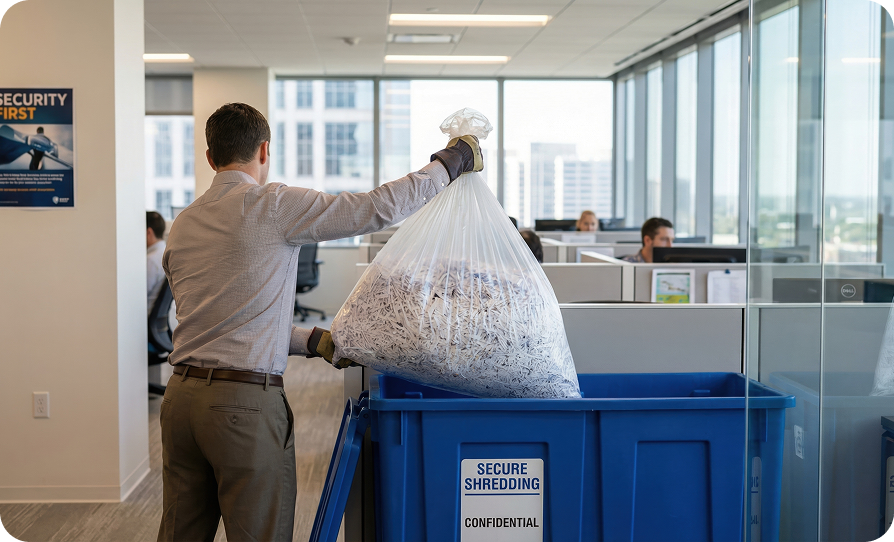
If you have a backlog of old paperwork that has passed its retention period, Just Shredding can help. We deliver heavy-duty shredding bags to your door, you fill them at your own pace, and we collect them free of charge. Every bag is securely destroyed using cross-cut shredding and you receive a certificate of destruction for your records.
Prices start from just £4.14 per bag, with no minimum order and no contract. Order your shredding bags online or call us on 01249 471758 to get started.
Comments are closed.
